 Visit Lisbon Guide
The 1755 Lisbon Earthquake: What Fell, What Stood, What You Walk Through
The 1755 Lisbon earthquake is the reason the centre of the city looks the way it does (see things to see in Lisbon): why Baixa is a grid of straight streets between two squares when every other old district is a tangle, why the church on the Chiado hill has no roof, why Alfama is the only part of the lower city that is medieval. It struck at about 09:40 on the morning of 1 November 1755 — All Saints' Day, with the churches full — and it came in three acts: the shaking, the sea, and then the fire that burned for days. This page sets out what happened, prints the death toll as the contested figure it has always been rather than picking one, explains the grid and the timber cage that Pombal's engineers built in reply, and lists the places where the earthquake is still visible today, each with its hours and price as read on 29 August 2026 — or 'not stated' where the venue prints none. Dollar figures are approximations at €1 = $1.17.
Quick answer The morning in three acts, the contested toll, and where to see it now
On 1 November 1755, at about 09:40, an earthquake now estimated at between magnitude 7.7 and 9.0 struck from an epicentre in the Atlantic some 200 kilometres south-west of Cape St Vincent. The shaking lasted several minutes; a tsunami of at least six metres came up the Tagus into the lower town within the hour; the fires that followed burned for days. Roughly 85 percent of the city's buildings were destroyed. How many people died is still argued — the contemporary counts run from 6,000 to 40,000 for Lisbon alone, and modern estimates from 30,000 to 40,000 for the city — and this page prints the range, not a number. What replaced the ruins is the Baixa grid you walk through today.
Key takeaways
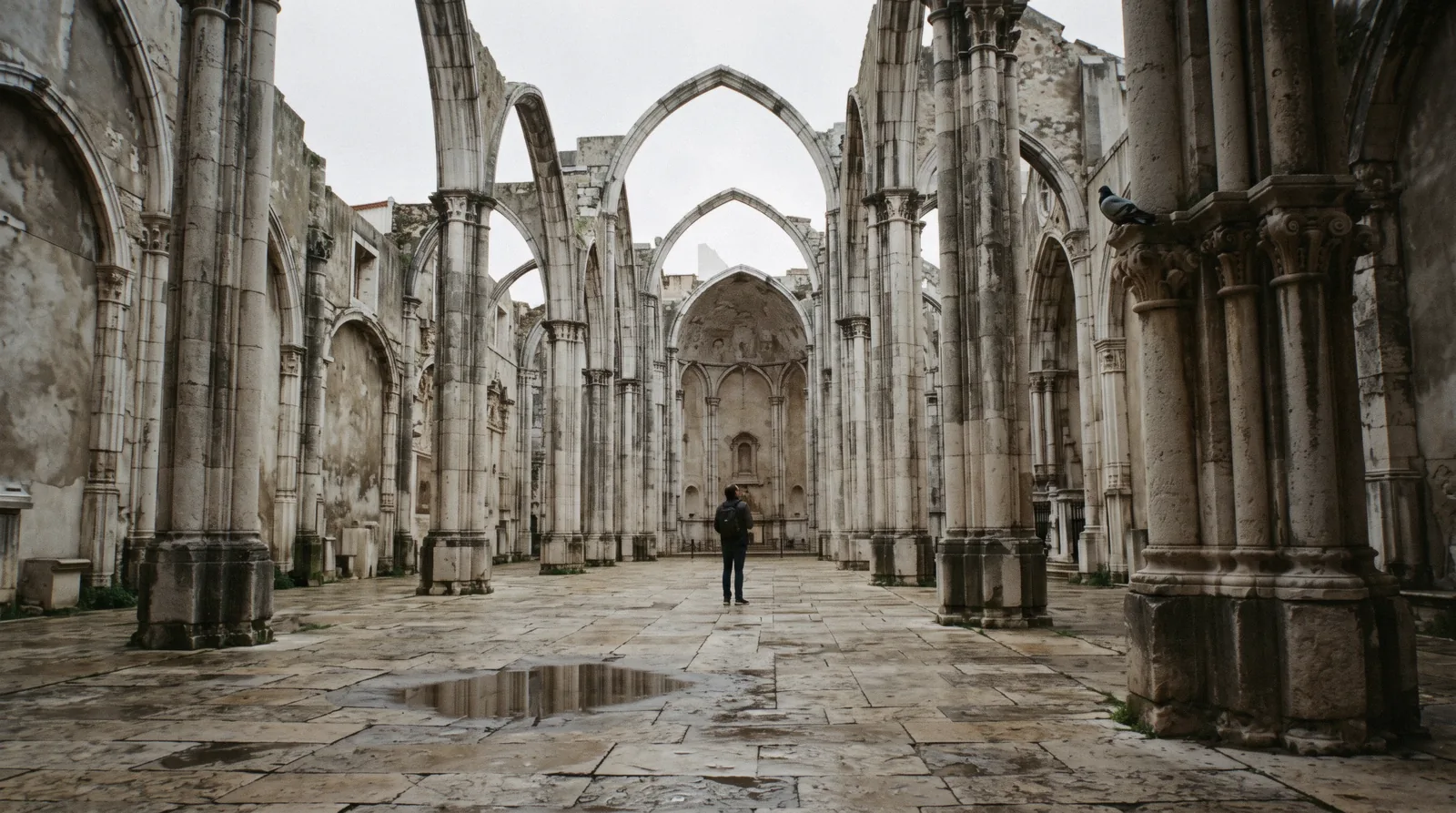
- The most legible ruin is the Carmo Convent, whose nave lost its roof that morning and was never given one back: €7 (about $8.20), Monday to Saturday, closed Sundays
- The reply to the earthquake is Baixa itself — Pombal's grid of 12-metre streets and the gaiola pombalina, a timber cage inside the walls that was Europe's first earthquake-resistant building system
- The district that stood is Alfama, on rock below the castle, which is why it is the one part of the lower city where the medieval street plan survives
- The one square the earthquake made is Praça do Comércio, laid out on the site of the royal palace the sea and the fire took; the Lisboa Story Centre on its east side tells the story in an hour, hours 10:00 to 19:00, price not printed on its site
- The Quake museum in Belém prints hours of 10:00 to 18:00 and an address on Rua Cais da Alfândega Velha, and no ticket price we could read; the museums hub sets it beside the rest
The morning of 1 November 1755, in three acts
About 09:40: the shaking
All Saints' Day is a holy day of obligation, and at twenty to ten in the morning the churches of Lisbon were full for the first masses. The earthquake that struck then had its origin under the Atlantic, roughly 200 kilometres south-west of Cape St Vincent, and seismologists have since placed it anywhere between magnitude 7.7 and 9.0 — there were no instruments, so every figure is a reconstruction from the damage and the accounts. The shaking came in more than one shock; a contemporary study of the accounts, summarised by the historian Ana Cristina Araújo, gives the first at around 09:40, lasting six to seven minutes in total across its tremors, with two stronger aftershocks the same morning and lesser tremors continuing for a little over six months.
The damage was worst where the ground was worst. The lower town between the two hills stands on alluvium and reclaimed riverbank, and there the intensity reached the top of the scale; the Royal Palace on the waterfront, the opera house that had opened only that spring, and the Patriarchal church all came down completely. Of the city's forty parish churches, sixteen collapsed or burned and nineteen were left in ruins; of sixty-five convents, eleven remained standing. At the Carmo, on the Chiado hill, the church roof fell into the nave onto the congregation, and the convent's library of some 5,000 volumes was destroyed.
Within the hour: the sea
Survivors who had run from the collapsing streets to the open riverfront — the quay, the palace square, the boats — were in the worst possible place. The earthquake had displaced the seabed, and the tsunami that followed came up the Tagus in three major incursions. The height in Lisbon is given as at least six metres, with some accounts putting the waves above ten; on the North African coast the same wave is estimated at up to twenty metres, and it was recorded at three metres as far as Cornwall. The marble quay called the Cais de Pedra, crowded with people, went under and was not seen again.
The waterfront you stand on today at Praça do Comércio is not the ground of 1755. The square was laid out on the site of the palace the water and the fire took, and the Cais das Colunas, the two columns at the water's edge, are Pombal's, not the old king's.
Then the fire, for days
The third act did more damage than the first two in the parts of the city the sea did not reach. Kitchen hearths and the candles of All Saints' altars were overturned in thousands of buildings at once; the accounts also blame looters. The fires burned for four days, and the wind carried them across the lower town and up the slopes.
Survivors were found asphyxiated tens of metres from the flames. What the shaking had left standing in Baixa the fire finished, which is why almost nothing below the Rossio is older than the reconstruction, and why the ruins that survive as ruins — the Carmo above all — are on the hills where the fire did not close in.
How many died: the figures, and who gave them
There has never been a count, only estimates, and the estimates disagree by a factor of six. The rows below are the figures as printed in the sources named, read on 29 August 2026: the contemporary reports summarised in Ana Cristina Araújo's article for Storicamente, and the modern ranges on the English and Portuguese Wikipedia articles, which cite the economic historian Álvaro Pereira's 2009 study among others. Print the range, not a number; anyone who gives you one figure has chosen it.
| Source | Deaths in Lisbon | Note |
|---|---|---|
| The Marquis of Pombal, to the government | 6,000 to 8,000 | Deliberately low, the historian notes, to prevent public alarm |
| Father Antony of the Sacrament, contemporary | At least 18,000 | A cleric's report from the weeks after |
| The Apostolic Nuncio, contemporary | 40,000 | The highest of the contemporary figures |
| Modern estimate, English Wikipedia (citing Pereira, 2009) | 30,000 to 40,000 | With about 10,000 in Morocco; 40,000 to 50,000 in total for the earthquake |
| Modern estimate, Portuguese Wikipedia | 30,000 to 40,000 | But with 50,000 to 60,000 more in the rest of Portugal and about 5,000 in Spain, for a total above 100,000 |
| As a share of the city | About 10 percent | On a population of roughly 250,000 |
The two Wikipedia articles agree on the Lisbon figure and disagree by a factor of two on the total, which is the state of the literature in miniature. The bodies were never counted: Pombal's answer to the dead in the streets was barges loaded with corpses and sunk in the Tagus estuary, for fear of plague.
Pombal's answer: the gallows, the survey, and the grid
Sebastião José de Carvalho e Melo, later Marquis of Pombal, was the king's chief minister, and the earthquake made him the most powerful man in Portugal for the next two decades. The line attributed to him — bury the dead and feed the living — is, the historian T. D. Kendrick noted, apocryphal; what he actually did is better documented.
Within twenty-four hours the government had fixed the prices of food, wages and rents at their level before the earthquake, sent troops to stop able-bodied survivors leaving the city, and started hanging looters on gallows raised at the ruins — the manhunts and summary executions are in every account. Then came the thing that made him a precursor of seismology: a questionnaire sent to every parish in the kingdom, asking at what time the shaking began, how long it lasted, how many died, whether the sea rose and by how much, whether wells changed. The answers are still in the national archive, and they are the reason the 1755 earthquake is the first ever studied scientifically across a whole country.
The rebuilding was handed to military engineers. Manuel da Maia, then in his seventies, drew up the options, from restoring the old streets to abandoning the site altogether; Eugénio dos Santos designed the plan that was chosen, a grid of streets fixed at forty feet — twelve metres — wide, running between the Rossio and a new square on the river. The old Terreiro do Paço became Praça do Comércio, opened on its south side to the Tagus and enclosed on the other three by uniform arcaded ministries. The Baixa page walks the grid street by street; the Praça do Comércio page has the arch and the square.
The gaiola pombalina
Inside every Pombaline building is the gaiola, the cage: a lattice of timber, braced diagonally like a St Andrew's cross, built into the masonry walls, floors and roof so that the structure can flex in a tremor and stay up even if the stone facing falls away. It is the first earthquake-resistant building system in Europe, and the engineers tested it the only way they could — by marching troops around a model to shake it. Beneath the buildings, timber piles were driven into the wet ground of the old riverbank, and it is the salt water that has kept them elastic and free of rot for 270 years.
The buildings were also, in a sense, prefabricated: the standard elements were made outside the city, carried in and assembled on site, which is why the façades on one block of Rua Augusta are the façades on every block, four storeys, shops behind arcades at street level, balconies on the first and top floors. It looks like an aesthetic and it was a production line. The style took Pombal's name; the city took his plan.
What stood, and why
Alfama survived because of what it stands on. The district climbs the rock below the castle, and rock does not amplify a tremor the way the alluvium of the lower town does; the fire, coming from the west, did not close on it either. That is why Alfama is the one part of the lower city where a medieval street plan survives — alleys, steps and dead ends that predate the earthquake, in a city that otherwise begins in 1755. It is not untouched: the cathedral at its foot lost its Gothic chancel and had to be rebuilt in parts, and the castle on the summit was damaged. But the fabric between them is the old city, and the Alfama page walks it.
Belém, six kilometres west, stood too, which is the reason the Jerónimos Monastery and the Belém Tower are Manueline originals rather than reconstructions; the monastery's choir vault fell and was rebuilt, but the cloister and church are what they were. And the Carmo stood, in the sense that matters here: the walls and the pointed arches of the nave held while the roof came down, and successive attempts to rebuild it were abandoned — the convent became a police garrison in 1810, a court in 1834, a sawmill a year later, and from 1864 the archaeological museum it still is. The roofless nave was left as it was, and it is the single best place in the city to understand the morning. To walk that morning's geography for yourself, the guided walking tours of Lisbon cover Alfama, Belém and the Carmo in a single route.
Where to see the earthquake today
Four places, each with what the venue itself printed when we read it on 29 August 2026. Two of them print no ticket price on any page we could reach, and this page says so rather than copying a figure from a reseller.
| Place | What it shows | Hours, as printed | Price, as printed |
|---|---|---|---|
| Carmo Convent, Largo do Carmo | The roofless nave itself, and the archaeological museum in the chancel | Monday–Saturday 10:00–19:00 May to October, 10:00–18:00 November to April; closed Sundays, 1 January, 1 May, 25 December | €7 adult (about $8.20), €5 reduced, under-15s free |
| Baixa Pombalina | The grid, the uniform façades, the gaiola behind them | A street: always | Nothing |
| Lisboa Story Centre, Terreiro do Paço 78–81 | A 60-minute multimedia walk through the city's history with the earthquake as its centrepiece | 10:00–19:00, last entry 17:45 | Not stated on lisboastorycentre.pt |
| Quake, Rua Cais da Alfândega Velha 39, Belém | An immersive earthquake museum: the science and the simulation of the morning | 10:00–18:00 as printed on the homepage; closed days not stated | Not stated on any lisbonquake.com page we could reach |
Go to the Carmo first and on a clear morning: the arches read against the sky, and the museum in the chancel behind them holds Gothic tombs and, in a room at the back, the mummies that make children remember the visit. From the Largo do Carmo the Santa Justa lift's upper walkway used to be the way down to the Rossio; it has been closed since the 3 September 2025 Glória derailment, so it is the stairs by the convent instead. Then walk the grid downhill to the square, which is the whole reconstruction in fifteen minutes, and turn east into Alfama to see what the grid replaced.
The two museums are for different visitors. The Story Centre is on the square you are already standing in and takes an hour; the Quake is in Belém, which is a half-day journey in itself, and it is built for families and for anyone who wants to feel the floor move. The museums hub sets both beside the city's other collections, and the rainy-day page is where they earn their place in an itinerary.
Why it mattered beyond Lisbon
The earthquake arrived in Europe's newspapers within weeks and in its philosophy within the year. Voltaire wrote a poem on the disaster in 1756 and then put it into Candide, where the earthquake is the moment the doctrine that all is for the best in the best of possible worlds stops being tenable; Kant published three essays on it the same year, working out a physical theory of earthquakes from the reports. The argument the disaster started — how a good God permits a city full of people at mass to be killed on a holy day — is the one the eighteenth century never settled, and it is why a Portuguese earthquake sits in the history of ideas as well as the history of seismology.
In Portugal the consequences were political as much as intellectual. Pombal used the emergency to build the state he wanted: the survey, the price controls, the engineers, and within a few years the expulsion of the Jesuits and the execution of the Távora family, both of which he tied to the aftermath. The city he rebuilt is the argument for him; what he did to get it built is the argument against. The history of Lisbon's churches has the buildings that were put back, and the neighbourhoods hub sets the Pombaline centre against the districts that predate it.
Walking the earthquake with a guide, or on your own
The walking tours below cover Baixa, Chiado and Alfama, which is the earthquake's ground; the castle and cathedral tickets are the two buildings on the rock that stood. Prices are the euro figures listed on 29 August 2026.
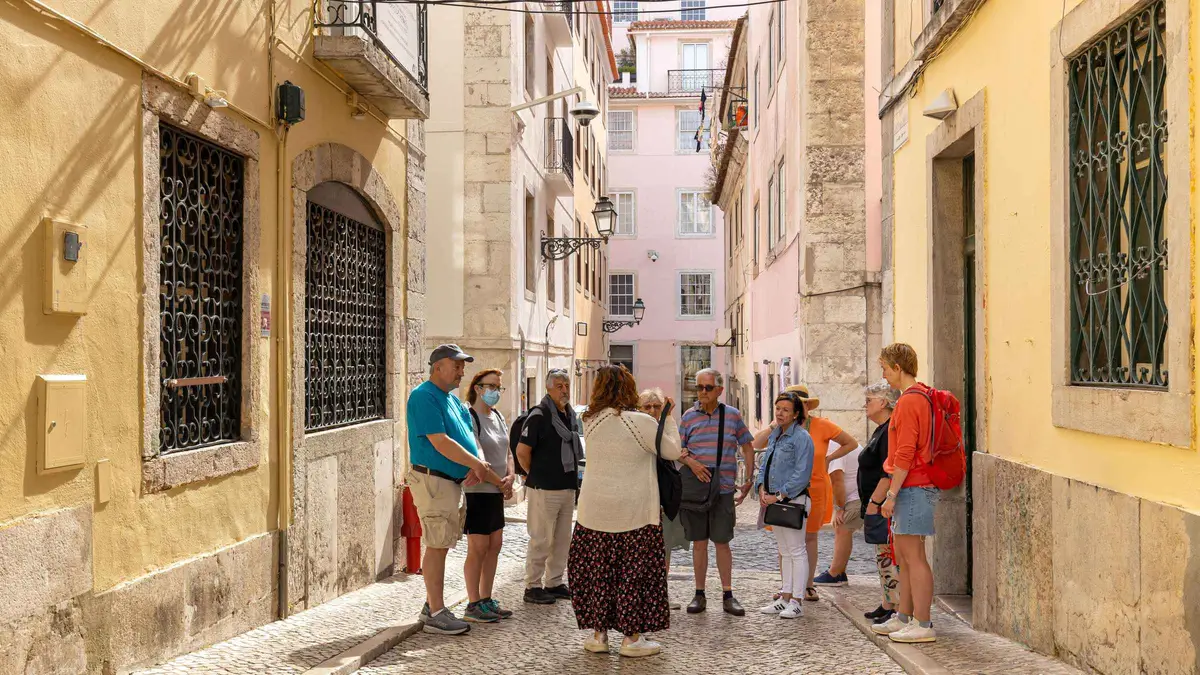 from €25
Lisbon: History, Stories and Lifestyle Walking Tour
listed at $28.96
Three-hour guided walk through Chiado and Bairro Alto up to the Miradouro de São Pedro de Alcântara, built around the city's history and everyday life. Hills and cobbles — wear proper shoes.
Check Availability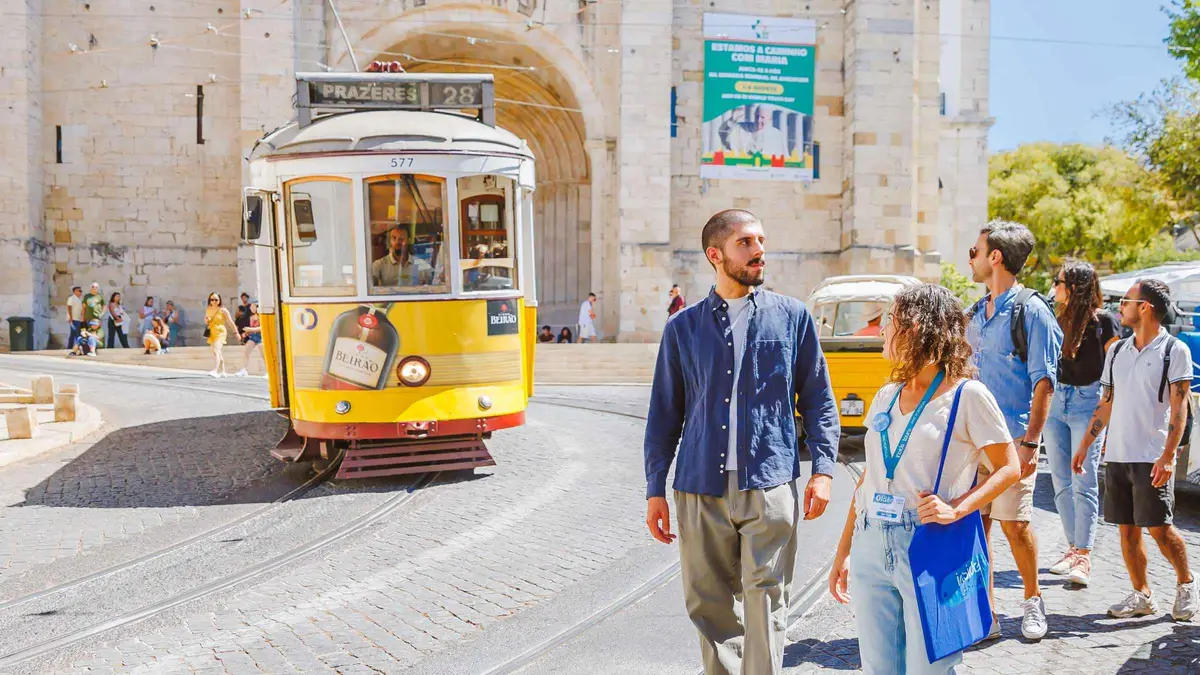 from €22
Best of Lisbon Walking Tour: Rossio, Chiado & Alfama
listed at $25.49
Three-hour walk from Rossio and the Carmo Church ruins through Chiado and Baixa into Alfama, with one pastry stop. The cheaper of the two city walks here.
Check Availability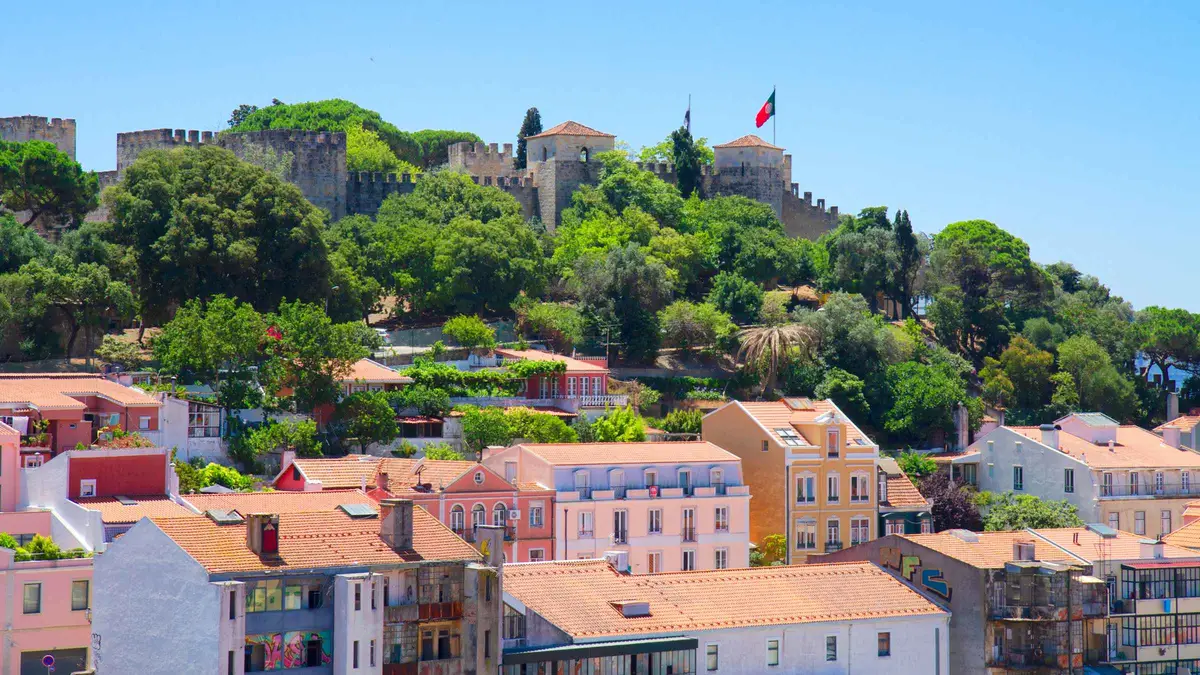 from €27
Lisbon: São Jorge Castle E-Ticket and Audio Guide
listed at $28.78
E-ticket to São Jorge Castle with a self-guided audio tour on your own phone; stay one to four hours. Bring headphones — the audio is your only guide.
Check Availability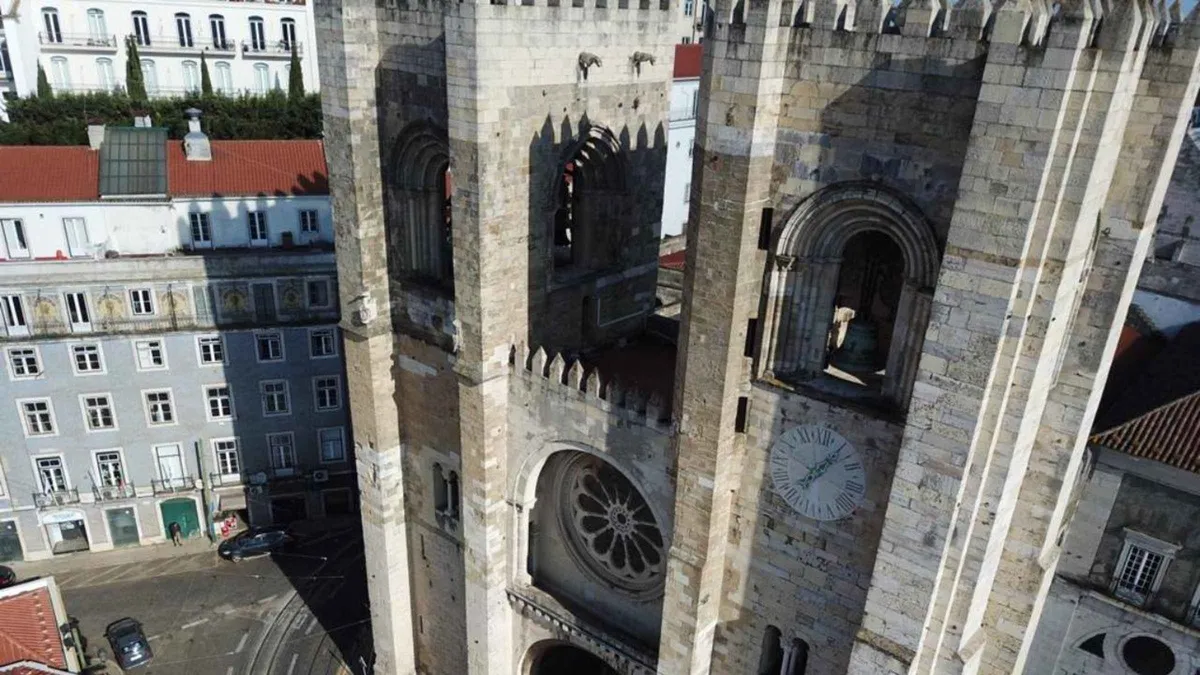 from €7
Lisbon: Lisbon Cathedral Entry Ticket
listed at $8.11
Seven-euro entry ticket to the Sé covering the baptistery, treasury, high choir and the balcony over Alfama. The nave itself is free — the ticket is for the extras.
Check Availability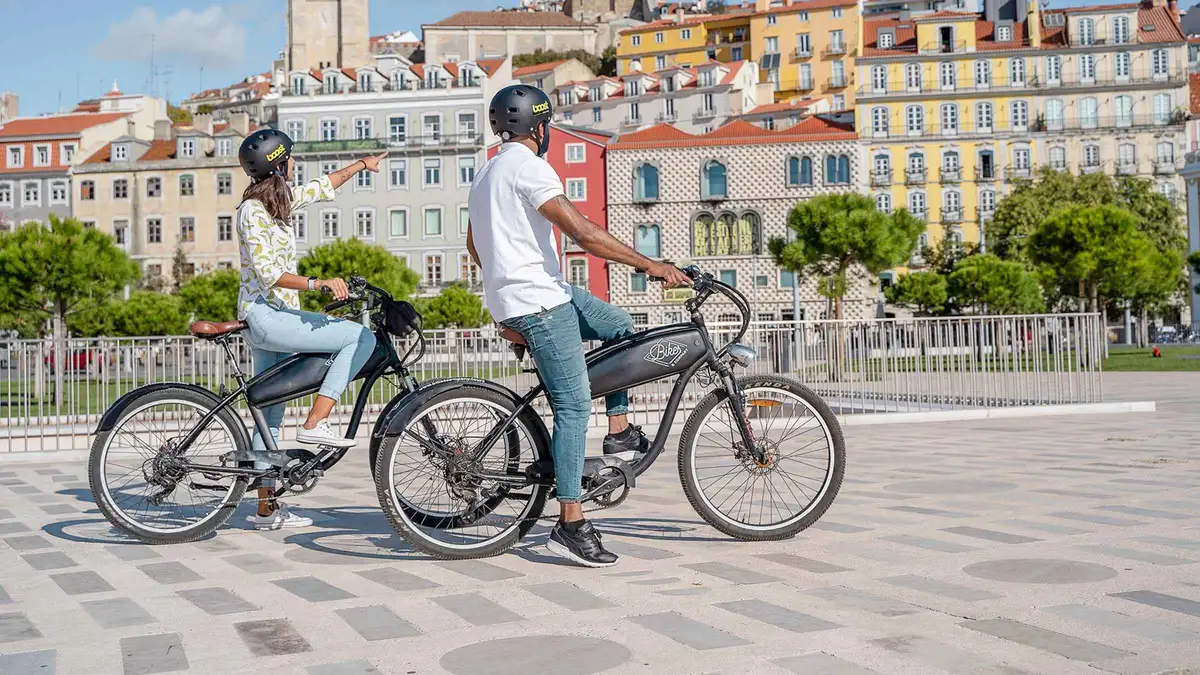 from €25
Lisbon: Hills, Alfama, and Mouraria Tour by Electric Bike
listed at $28.96
Three-hour e-bike ride through Alfama, Mouraria and Graça, using the motor to take the hills. Cobbles and traffic still demand a confident rider.
Check Availability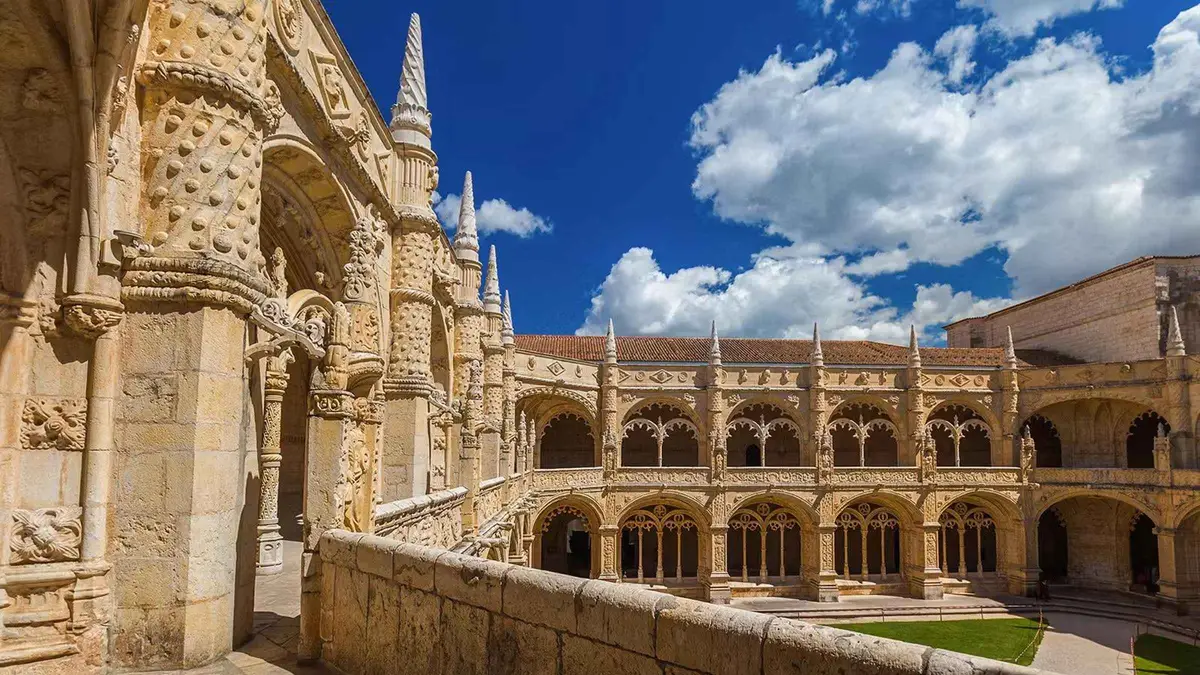 from €31
Lisbon Card: 24, 48, or 72-Hour Pass
listed at $35.91
One pass for public transport plus free entry to the attractions on the Lisboa Card list, in 24-, 48- or 72-hour versions. Only pays off if you pack in several paid sights per day.
Check AvailabilityPrices, ratings and details are the platform's own. Dollar figures are the listed prices. The platform bills in your account's currency.
The 1755 earthquake: the questions people ask
How many people died in the 1755 Lisbon earthquake?
Nobody knows, and the honest answer is a range. Contemporary figures for Lisbon run from Pombal's deliberately low 6,000 to 8,000 to the Nuncio's 40,000; modern estimates put the city's dead at 30,000 to 40,000 on a population of about 250,000, and the total for Portugal, Spain and Morocco anywhere from 40,000 to over 100,000 depending on the source. The table above prints each figure with who gave it.
How tall was the 1755 Lisbon tsunami?
At least six metres in Lisbon, with some accounts above ten; up to twenty metres on the coast of North Africa and three metres in Cornwall. It came up the Tagus in three incursions within about an hour of the shaking and took the crowded waterfront quay, which is why so many of the dead were people who had run to the river for safety. Praça do Comércio is built on the ground it covered.
What magnitude was the 1755 Lisbon earthquake?
Between 7.7 and 9.0 on the moment magnitude scale, which is the range seismologists give for an event with no instruments, reconstructed from the damage and the parish survey. The epicentre was under the Atlantic about 200 kilometres south-west of Cape St Vincent, and the shaking reached the top of the intensity scale in the lower town, where the ground is alluvium rather than rock.
Where can I see the effects of the earthquake in Lisbon today?
In the Carmo Convent, the roofless church on the Chiado hill, €7 and closed on Sundays; in the Baixa grid itself, which is the reconstruction; in Alfama, the district that stood; and in two museums, the Lisboa Story Centre on Praça do Comércio and the Quake museum in Belém, neither of which printed a ticket price on the pages we could read.
Why was the 1755 earthquake important?
Three reasons. It was the first earthquake studied scientifically, through the questionnaire Pombal sent to every parish; it produced the first earthquake-resistant building system in Europe, the gaiola pombalina inside the Baixa buildings; and it set off the argument in Voltaire and Kant about how a good world permits such a thing, which is why it sits in the history of philosophy as well as of seismology.
Is the Quake museum in Belém worth it, and what does it cost?
Its homepage prints hours of 10:00 to 18:00 and an address on Rua Cais da Alfândega Velha, and no page we could reach on 29 August 2026 printed a ticket price, so none is given here. It is built as an immersive experience with a simulation of the morning, which makes it the version for families; the Carmo is the version for anyone who wants the real ruin. The museums hub puts it beside the rest of Belém.
The Earthquake on Film
Three documentary accounts of the same morning: a full-length reconstruction, the BBC on why it changed how Europe thought, and a shorter narrative of the day.
The Great Earthquake of 1755: Lisbon's Nightmare
A full documentary reconstruction of the three acts — shaking, sea and fire — and the rebuilding that followed.
Video: hazards and catastrophesThe Earthquake That Changed History
The BBC's short film on why 1755 sits in the history of ideas, from Pombal's survey to Voltaire.
Video: BBC GlobalThe Terrible 1755 Lisbon Earthquake
A narrative account of the morning, useful before you stand in the Carmo nave.
Video: Timothy RoweVideos load from YouTube only when you press play.